

My wife’s 9th great-grandmother, Penelope Van Pinces, married Richard Stout, one of the earliest settlers of today’s Long Island, NY and later became known as the “Mother of Monmouth, NJ.” And she may also have:
- Survived a shipwreck on a voyage from the Netherlands to America
- Been attacked, severely injured, and subsequently rescued by American Indians
- Lived with an American Indian tribe for several years
- Died at 110 years of age
- Counted Abraham Lincoln among her descendants
Well, maybe.
There are dozens of accounts of Penelope’s Stout’s life. (I’ll include links to the best ones.) Her story was the subject of a “Ripley’s Believe it or Not” syndicated newspaper cartoon. There is a Penelope Stout Wikipedia page, Facebook group, several books, and even a commemorative coin declaring Penelope as the “First Lady of Monmouth County, NJ. This post is an attempt to summarize her life as accurately as possible. Key resources are linked in the post or noted at the end.
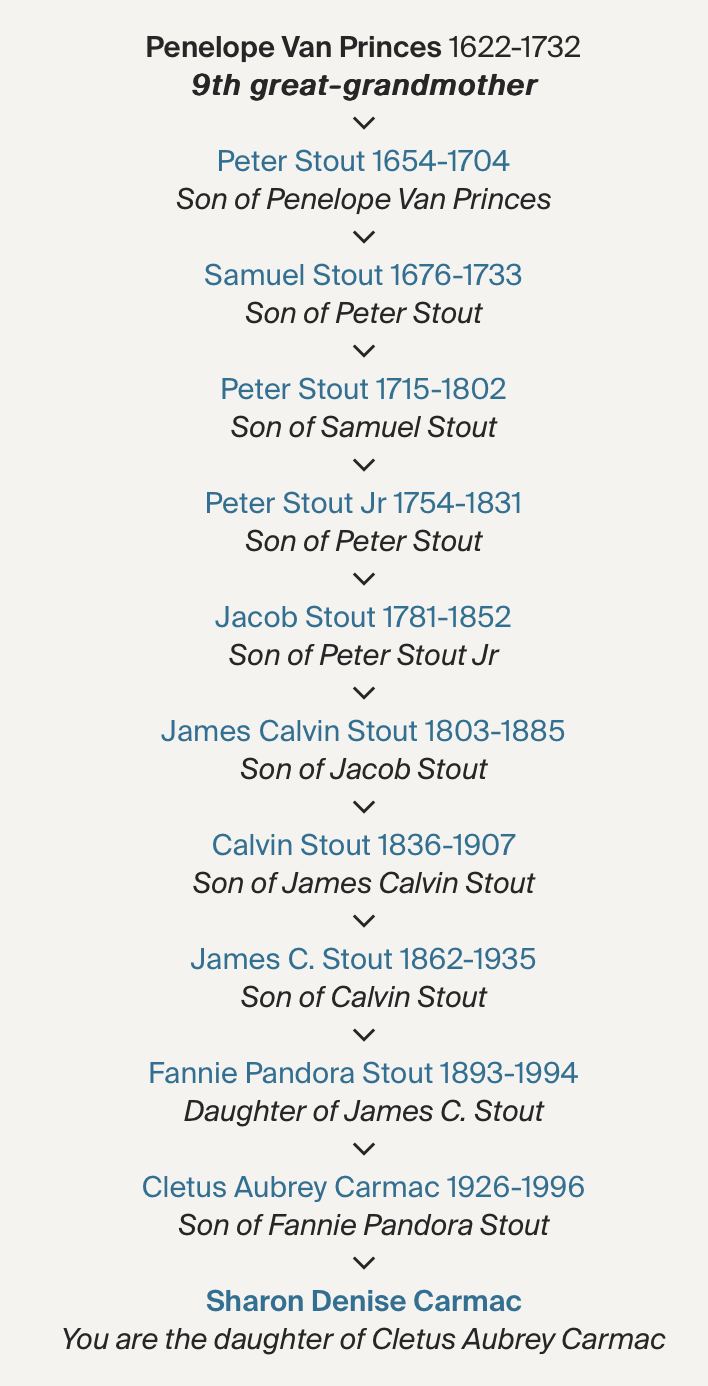
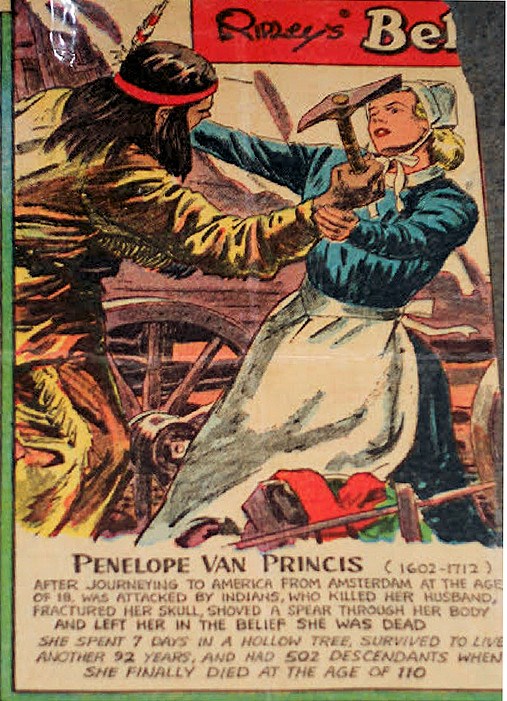
Penelope was most likely of English or Dutch origin and arrived in New Netherland (now the states of NY, NJ, PA, MD, CT, and DE) in the 1640s. She came by boat, probably in the company of a husband as it would have been unusual for a young woman to make the journey alone. There is not a definitive record of her birth year, but the most credible accounts estimate it to be around 1622. (I think it could have been a little later.)
The earliest written record of the story of Penelope is in the 1765 book The History of the Colony of Nova-Caesaria, or New-Jersey by Samuel Smith. In a chapter about the hostilities between American Indians and settlers of Bergen and Middletown, Smith recounts the oral tradition of an attack on survivors of a Dutch shipwreck off Sandy Hook, NJ. Similarly, the next written record of Penelope’s story is in Materials Towards a History of Baptists in Jersey written by Baptist historian Morgan Edwards in 1792. In 1813, David Benedict included the same version of the story when writing about the Stouts in A General History of the Baptist Denomination in America. Here’s a comparison of the versions, Smith’s on the left and Edwards/Benedict on the right.
“While New-York was in possession of the Dutch, about the time of the Indian war in New-England, a Dutch ship coming from Amsterdam, was stranded on Sandy Hook, but the passengers got on shore; among them was a young Dutchman who had been sick most of the voyage; he was taken so bad after landing, that he could not travel; and the other passengers being afraid of the Indians, would not stay till he recovered, but made what haste they could to New-Amsterdam; his wife however would not leave him, the rest promised to send as soon as they arrived: They had not been long gone, before a company of Indians coming down to the water side, discovered them on the beach, and hastening to the spot, soon killed the man, and cut and mangled the woman in such a manner that they left her for dead. She had strength enough to crawl up to some old logs not far distant, and getting into a hollow one, lived mostly in it for several days, subsisting in part by eating the excrescences that grew from it; the Indians had left some fire on the shore, which she kept together for warmth: having remained in this manner for some time, an old Indian and a young one coming down to the beach found her; they were soon in high words, which she afterwards understood was a dispute; the former being for keeping her alive, the other for dispatching: After they had debated the point a while, the first hastily took her up, and tossing her upon his shoulder, carried her to a place near where Middletown now stands, where he dressed her wounds and soon cured her: After some time the Dutch at New-Amsterdam hearing of a white woman among the Indians, concluded who it must be, and some of them came to her relief; the old man her preserver, gave her the choice either to go or stay; she chose the first: A while after marrying to one Stout, they lived together at Middletown among other Dutch inhabitants.”
“The origin of this Baptist family is no less remarkable; for they all sprang from one woman, and she as good as dead; her history is in the mouths of most of her posterity, and is told as follows: She was born at Amsterdam, about the year 1602; her father’s name was Vanprincis; she and her first husband, (whose name is not known) sailed for New York, (then New Amsterdam) about the year 1620; the vessel was stranded at Sandy Hook; the crew got ashore, and marched towards the said New York; but Penelope’s (for that was her name) husband being hurt in the wreck, could not march with them; therefore, he and the wife tarried in the woods; they had not been long in the place, before the Indians killed them both, (as they thought) and stripped them to the skin; however, Penelope came to, though her skull was fractured, and her left shoulder so hacked, that she could never use that arm like the other; she was also cut across the abdomen, so that her bowels appeared; these she kept in with her hand; she continued in this situation for seven days, taking shelter in a hollow tree, and eating the excresence of it: the seventh day she saw a deer passing by with arrows sticking in it, and soon after two Indians appeared, whom she was glad to see, in hope they would put her out of her misery; accordingly, one made towards her to knock her on the head, but the other, who was an elderly man, prevented him; and throwing his matchcoat about her, carried her to his wigwam, and cured her of her wounds and bruises; after that he took her to New York, and made a present of her to her countrymen, namely an “Indian” present, expecting ten times the value in return. It was in New York, that one Richard Stout married her: he was a native of England, and of a good family; she was now in her 22d year, and he in his 40th. [She] lived to the age of 110, and saw her offspring multiplied into 502 in about 88 years.”
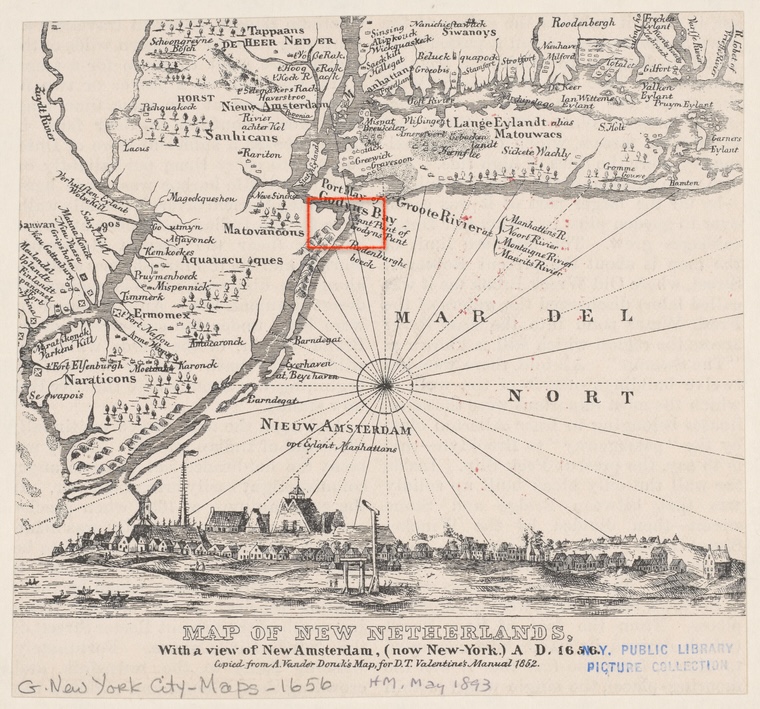
Some corroborating events are:
- At the time of their journey, there was a “war” between Dutch settlers and American Indians in New Netherland.
- A Dutch ship named Kath or de Kath is documented to have grounded off Sandy Hook in the 1640s.
Nathan Stout wrote and published The Stout Family History in 1823 providing the first genealogical examination of Richard and Penelope. Nathan’s version of Penelope’s story is pretty much the same as earlier accounts, but he says an Indian and his dog found and rescued Penelope. Other versions add that the American Indian that rescued Penelope continued to visit her on occasion and even warned her of an attack to protect her family. It’s also suggested the relationship may have contributed to her eventual relocation with her husband, Richard Stout, to the Jersey colony. (More on that later.) Obvious embellishments aside, Professor Jeanne Vloyanetes of Brookdale Community College notes a consistency in the fundamental elements of the story such as a wrecked or disabled ship at Sandy Hook, death of a husband, the injuries to Penelope, an attack and rescue (both by American Indians), and marriage to a Stout.
The exact year Penelope married Richard Stout is a guess, but many historical accounts suggest 1644. We know Richard was one of the first settlers of Gravesend, Long Island, founded in 1643. Most Stout family histories show their first child, John, with a birth year of 1645, and I doubt there would have been a birth out of wedlock. So 1644 seems plausible. However, a “Penelloppe Prince” appears in the 1648 Gravesend Town Book where she testified in a slander trial. (I haven’t been able to find the record online, but enough researchers have cited its authenticity and existence in the New York City archives.) I don’t have an explanation for why her name isn’t “Stout” instead of “Prince,” but it seems unlikely there would be two people with the same name in a small settlement. A few articles point out it was common for Dutch women to use their maiden name.
Richard Stout was born in England around 1615 and joined (perhaps involuntarily) the British Navy as a young man. His service took him to New Amsterdam where he stayed after being discharged (or deserting) and became a mercenary fighting for the Dutch against the indigenous people inhabiting the region. Richard eventually became a Dutch citizen and joined the Anabaptists settling Gravesend in 1643. He became a successful tobacco farmer and was the largest landowner in Gravesend by the 1660s. Penelope and Richard had ten children: John (1645), Richard (1646), James (1648), Mary (1650), Alice (1652), Peter (1654), Sarah (1656), Jonathan (1660), David (1667), and Benjamin (1669).
The Stouts moved across the bay to New Jersey in 1664 around the time the Dutch surrendered New Amsterdam to the English. Around 20 settlers of Gravesend were already negotiating the purchase of land with the Native Americans living in the area. According to the History of Monmouth County, on January 25, 1664, the settlers completed the purchase by paying the chiefs of the Indigenous people:
“118 fathoms seawamp [beads]; 68 fathoms of which were to be white and 50 black; 5 coats; 1 gun; 1 clout [cloth] capp; 1 shirt; 12 pounds of tobacco; and 1 anker of wine [around 2o gallons]. All of this has been acknowledged as having been received and, in addition, 82 fathoms of seawamp was to be paid twelve months hence.”
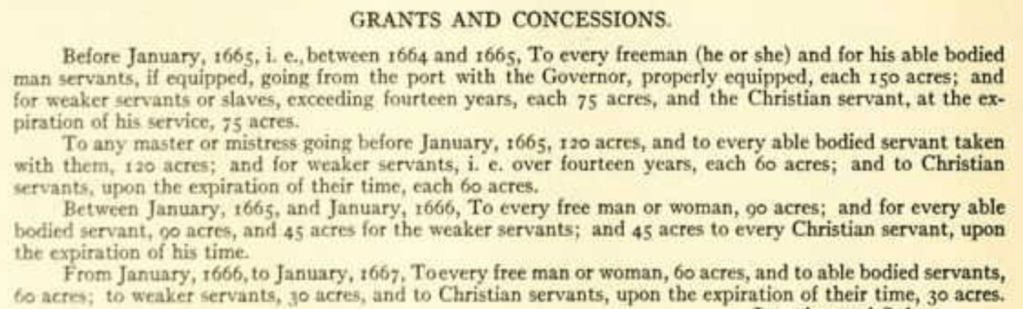
As a Monmouth patentee, Richard received 480 acres for himself, 120 acres for Penelope, and 120 acres each for their oldest sons, John and Richard. Younger sons James and Peter, and daughters Mary, Alice and Sarah, each received 60 acres. Sons Jonathan, David and Benjamin were not named as they were too young or born after the 1664 grants. The future husbands of Mary (James Bowne) and Alice (John Throckmorton) also secured grants of 240 acres.
According to Penelope’s legend, not long after the Stouts and other settlers founded Middletown, the Indian that saved Penelope years before appeared at the Stout’s home to warn that the tribes were coming to attack the settlement. He urged Penelope to take the family and flee to safety in his canoe. Penelope gathered the younger and left to seek help from New Amsterdam. Richard and the men of the settlement gathered their firearms and sent the women and children in canoes to wait offshore while they waited. The Indians came during the night, but the settlers repulsed the attack with their superior weapons. Richard and the settlers asked for a parley and came to an agreement that satisfied both sides.
As the Middletown settlement grew, Richard was appointed as a surveyor for dividing land and laying out the lots. He was briefly a member of the first New Jersey General Assembly in 1671 and served as Indian Commissioner (perhaps as a result of the negotiations of legend) in 1675. Settlers organized the first Baptist church in New Jersey and met at the Stout home from 1668-1688. Richard and his oldest son, John, were among the eighteen male charter members. For 20 years, the members met every Sunday at the Stout home or the homes of other members until a log church was built.
Richard died in 1705 and his will is on file in the Office of the Secretary of State of Trenton and signed with an “x.” Penelope inherited the orchard, all horses except one mare and colt. and “the rooms of the house she lives in with the cellar and all the land. ” He gave his home farm to his youngest son, Benjamin, and one shilling each to the other children.
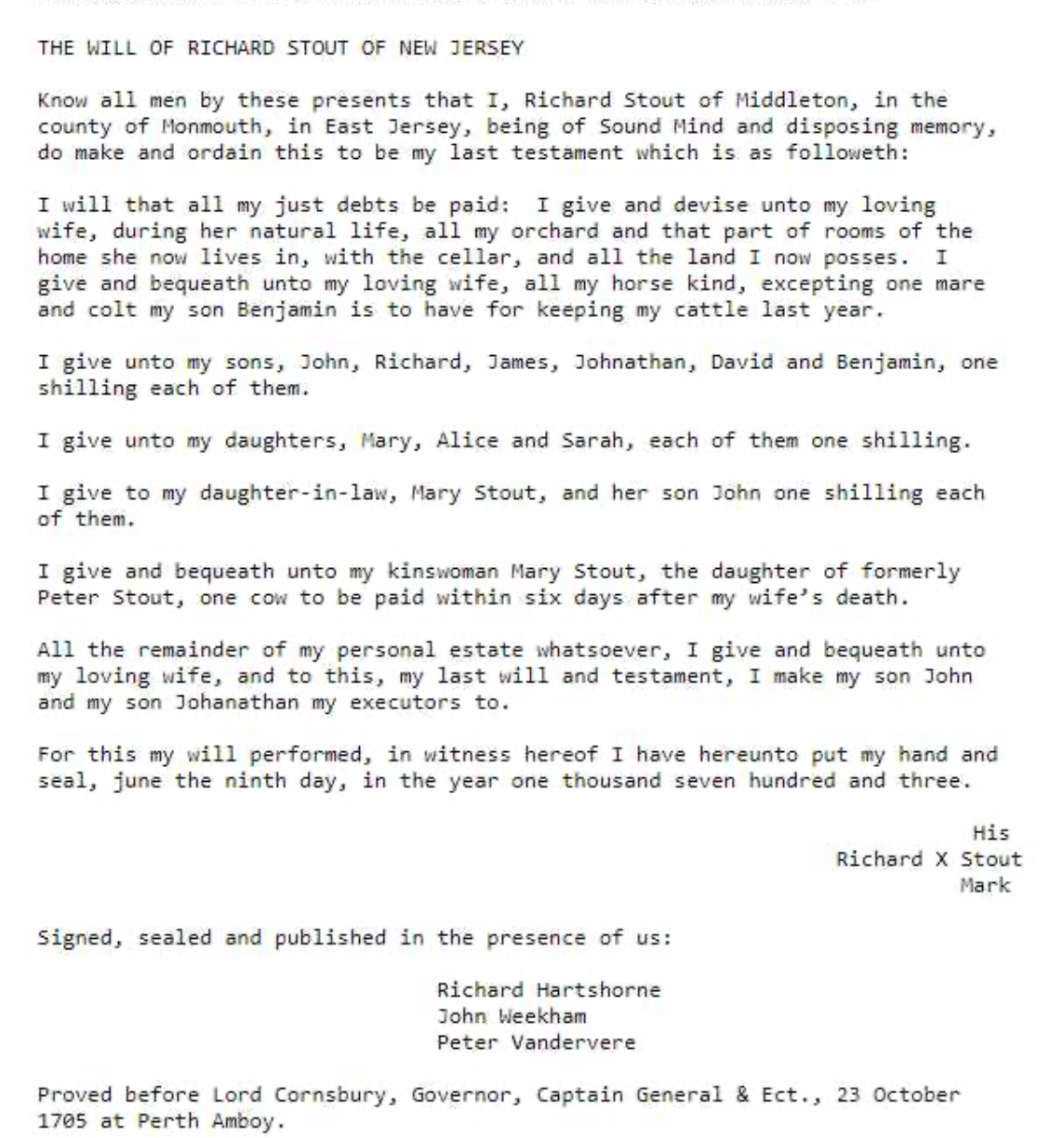
We know from Richard’s will that Penelope was alive in 1705, but it’s hard to believe she lived another 27 years and died in 1732 at the age of 110. In his 1915 book, The Stout Family of Delaware, Thomas Hale Streets recorded 1712 as the year of her death which is far more plausible.
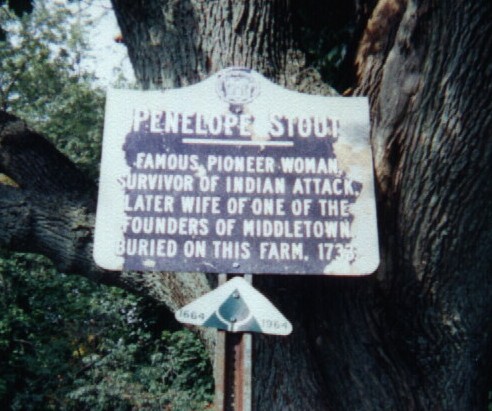
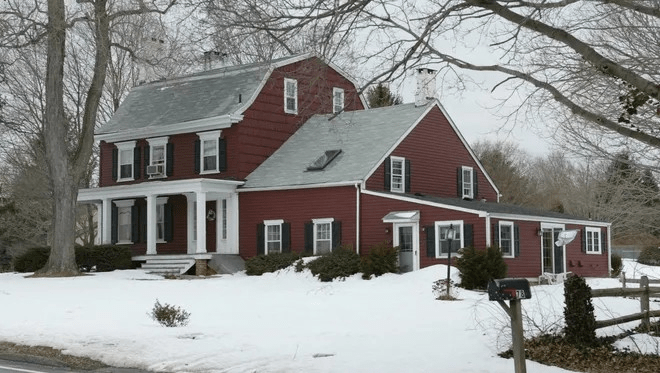
Where Richard and Penelope were buried is unknown, but many believe the graves are near the “Penelope Stout House” on Crawfords Corner Road in Holmdel, New Jersey. The 300-year-old structure was demolished in 2006 after attempts to save it failed. There is no headstone, but a historic marker noting her grave once stood nearby.
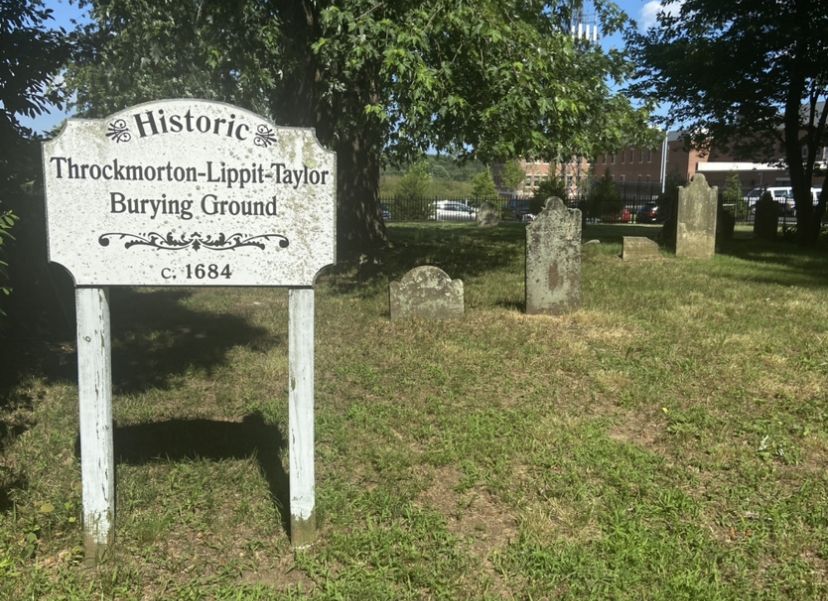
The Throckmorton-Lippit-Taylor burying ground, the oldest recorded family burying ground in Middletown, is another possibility. John Throckmorton, Sr. was a peer of Richard Stout, and his son, John, Jr. married Alice Stout. The graveyard is located on Penelope Lane in the Middletown Historic District.
So what are the conclusions? There’s no doubt Penelope existed and produced one heck of a legend. I believe it’s likely she did travel to America on a Dutch ship, the ship encountered some difficulty, and there was an interaction (perhaps unfriendly) with Indians. We know Penelope married Richard Stout and had ten children, but odds are she did not live to be 100 years old. As for Abraham Lincoln being a descendant, well…close, but not really. Dann Morton explains the confusion in his blog, so I’ll skip rewriting it.
One of Penelope’s great-grandsons, Peter Stout, brought his family to Cane Creek in Piedmont NC in 1762, so just about every person in the area with a “Stout” in their lineage is a descendant of this wonderful woman.
Resources of note:
- History of the Town of Gravesend, A.P. Stockwell
- Historical Collections of the State of New Jersey, John Barber and Henry Howe
- The History of the Stout Family (requires a FamilySearch account)
- Searching for Penelope Stout (blog)
- History of Monmouth County New Jersey, Franklin Ellis
- The Stout family of Delaware: with the story of Penelope Stout, Thomas Hale Streets
- Historical and Genealogical Miscellany: Data Relating to the Settlement and Settlers of New York and New Jersey, John Stillwell
 Forebears and Kinfolks
You must be logged in to post a comment.