

I previously collaborated with my cousin and fellow researcher Rich Marshall on locating and mapping the mid 1700s “Cox Settlement“ along Deep River in southeast Randolph County, NC. Rich has written about another “Cox Settlement,” this one being a couple generations later and in Indiana. Here’s what Rich writes, and he adds this is an unfolding story as his research continues.
About a hundred years earlier in 1725 or so, the Cox boys’ Great grandparents (William Cox & Catherine Kinkey Cox) were living on a 400 acre farm in the Delaware Valley. The land had been obtained from the daughter of William Penn….you know, the Quaker Oats chap! William and Catherine built a nice brick home for their growing family…which today is still being used as a single-family home.
Catherine is believed to have passed away in the 1740s, but the remainder of the family pulled up stakes and moved to Orange County, N.C. in the early 1750’s. What exactly was the motivation is unclear, but religious freedom and economic opportunity were likely high on their list of incentives. Other Pennsylvania and Delaware Quaker families moved to the area as well to take advantage of land grants being offered by the British elite. William Cox and his sons collectively obtained 13 grants in close proximity to one another along Deep River, totaling 5,864 acres. It was dubbed Cox’s Settlement, and was the hub of considerable commerce because of the Cox grist mills…two and perhaps three mills operating across the river from each other.
Joseph Cox (born 1767 in Orange County, NC), grandson of William Cox & Catherine Kinkey Cox, and son of William Cox II & Juiatha Carr followed some of his brothers westward and became the first settler of the newly formed Bartholomew County, Indiana. Today Joseph and his wife Mary Surginer Cox are recognized as the first settlers of Bartholomew County, IN. With their sons, this generation of the Cox family purchased 13 grants totaling 1040 acres in Bartholomew County. The Coxes obtained the grants by being at or near the front of the line when the Federal Land Office opened in 1821.
Grist mills and fruit orchards were standard features of the Cox land endeavors.
Pushing farther west and repeating the acquisition of land grants continued. Joseph and Mary Cox’s boys (Thomas b. 1790, Joseph b. 1792, Peter b. 1803 and Gideon b. 1806) obtained land grants in Fountain County, IN beginning in 1825. Following their quest for harnessing water power, Thomas, Joseph and Peter all obtained land grants near the Big Shawnee and Little Shawnee Creeks, about two miles upstream from where the Big Shawnee flows into the Wabash River. The community of Rob Roy just 4 miles south of Attica sprouted in 1826; and Wikipedia provides us with a good snapshot of town’s early development: Rob Roy, Indiana.
Another fine resource is History of Fountain County by H.W. Beckwith, H.H. Hill & N. Iddings Publishers 1881: Pg. 341 “Four brothers named Cox (Peter, Thomas, Joseph and Gideon) settled a large tract of land reaching from Big Shawnee to Little Shawnee….” And on Pg. 345 “Thomas Cox built (a mill) at the falls of Little Shawnee in 1824.” Therein lies my haunting question…where would that mill site be specifically…where are the falls on Little Shawnee Creek…can that site be located today?
Land Grant Records
A review of the Bureau of Land Management’s (BLM) General Land Office (GLO) database provides records about the specific acreage that the Cox brothers obtained by land grants:
Grants Near Big Shawnee & Little Shawnee Rivers
Thomas Cox
- Grant #1: 80 Ac. E 1⁄2 SE 1⁄4 of Section 19 of Township 21N 7W dated 4/15/1825
Peter Cox
- Grant #2: 80 Ac. E 1⁄2 NW 1⁄4 of Section 29 of Township 21N 7W dated 4/15/1825
- Grant #3: 80 Ac. W 1⁄2 SE 1⁄4 of Section 29 of Township 21N 7W dated 4/15/1825
Joseph Cox
- Grant #4: 80 Ac. E 1⁄2 NW 1⁄4 of Section 32 of Township 21N 7W dated 4/15/1825
- Grant #5: 80 Ac. W 1⁄2 SW 1⁄4 of Section 32 of Township 21N 7W dated 1/3/1828
Other Joseph Cox Grants in Fountain County
- 160 Ac. NE 1⁄4 of Section 28 of Township 22N 7W dated 7/25/1826
- 80 Ac. S 1⁄2 NW 1⁄4 of Section 1 of Township 19N 8W dated 1/10/1827
- 40 Ac. SE 1⁄4 NW 1⁄4 Section 23 of Township 22N 8W dated 1/30/1828
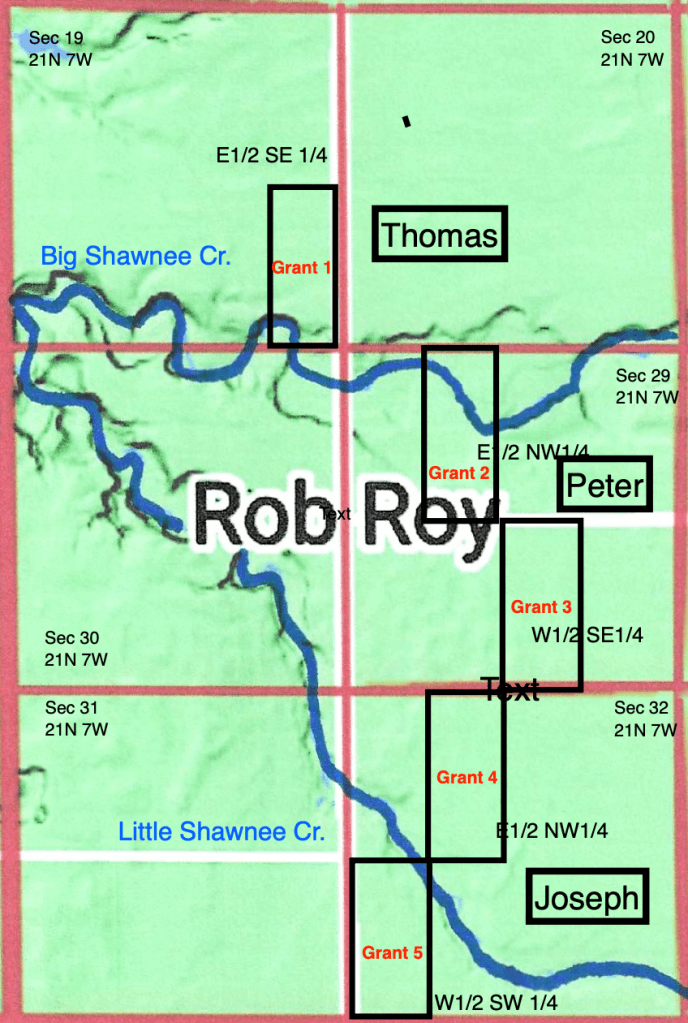
The map of Thomas, Peter and Joseph’s five grants place all in fairly close proximity to the Rob Roy community, just a bit upstream from where Big Shawnee and Little Shawnee Creeks flow together. The Thomas Cox 80 acre grant is just north of Rob Roy with a bit of the lower end of the grant crossing Big Shawnee Creek. This is one possible location for the Cox grist mill, and logically the reason this grant was chosen.
Peter Cox’s land grants were just south of Thomas’s grant with the more northerly grant (Grant #2) spanning Big Shawnee Creek. Is that where the Cox mill was located?
Joseph Cox’s land grants were again just a bit farther south, and his Grant #4 and Grant #5 could have provided a good mill site….were they on a ‘falls?’ Does someone know today where that mill would have been?
Additional Thoughts
As Thomas Cox moved on to Wilmington just a few years after his living in Fountain County, Indiana, it seems striking that he had witnessed the platting of Rob Roy by John I. Foster in 1826 and Cox’s next venture was the platting of Wilmington. Had Foster and the platting of Rob Roy been the idea/suggestion/boost that vaulted Thomas Cox toward becoming a land developer?
The Rob Roy plat was for just 48 lots; 36 of them were 54’ X 120’ and 12 lots were 41 1⁄2’ X 108’….but Cox’s lots in Wilmington were 12’ wider and 12’ deeper.. Any connection…or he just thought bigger was better? Wilmington’s plat was much bigger too. Approximately 400 lots were originally platted.
More to come…
 Forebears and Kinfolks
You must be logged in to post a comment.