

William Joseph Moffitt is my fifth great-grandfather. I descend from him through a daughter, Hannah, who married Jacob Cox (son of Harmon Cox), and also through a son, William, who married Mary Cox, granddaughter of Harmon Cox. The Moffitts and Coxes were among the first Quaker families to settle in the Deep River area of Randolph County, NC.
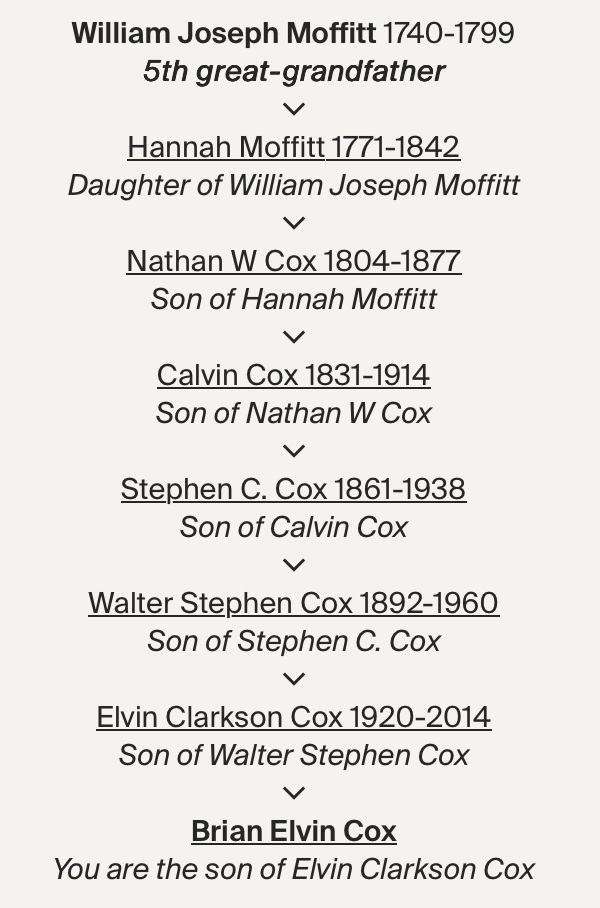
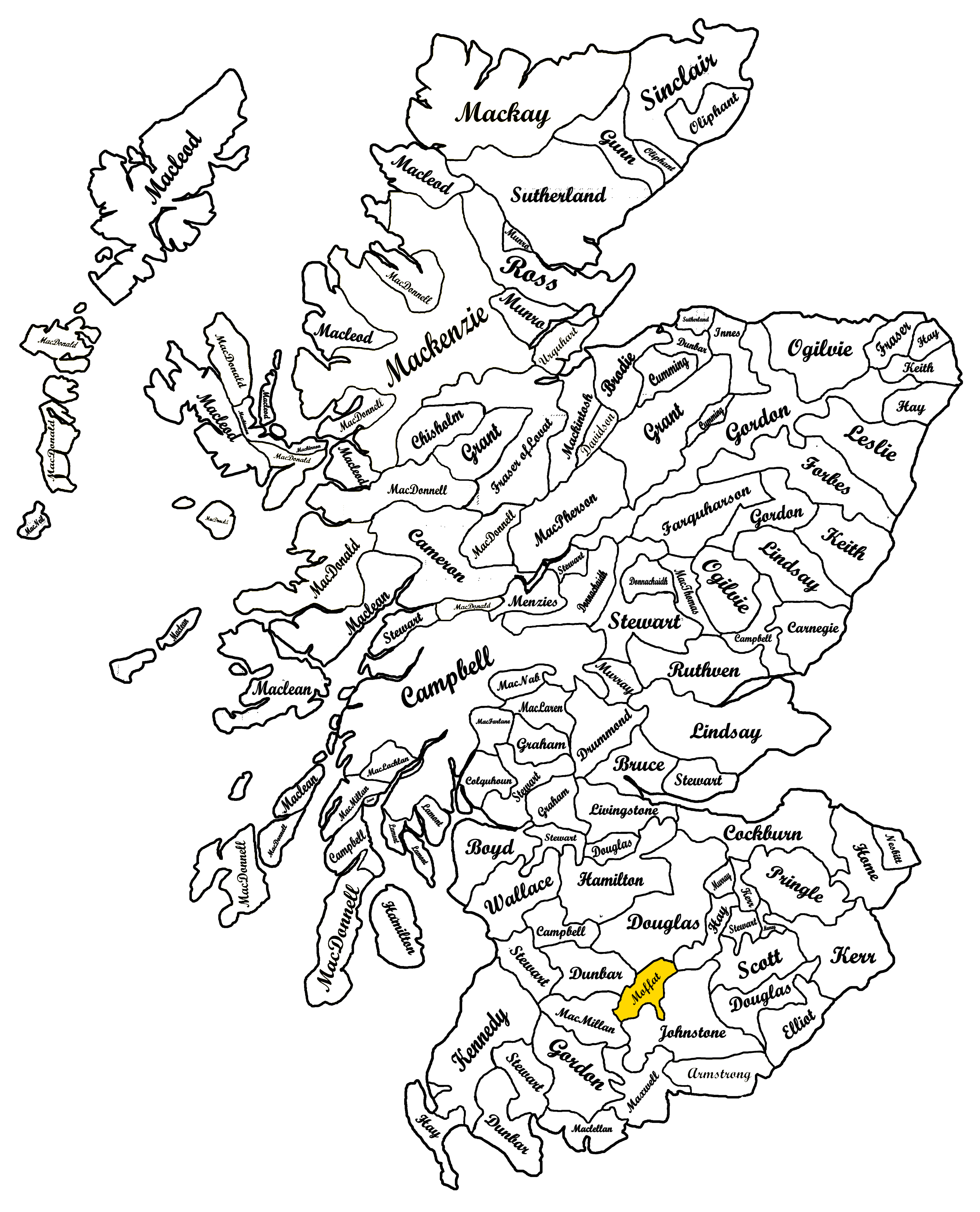
Documentation on William’s birth and early life is difficult to find and verify, but we know he was born in Northern Ireland around 1730-1740. I haven’t found a record of the exact date that I am confident is accurate. His father, Robert Bruce Moffitt (Moffat) was originally from Scotland’s Dumfriesshires area which is the home of the centuries old Moffat Clan. Robert married Margaret Stuart in 1732 and moved to Scotland to Ireland before William was born. More on them in a future post.
William arrived in America in the mid-to-late 1750s and lived initially in Pennsylvania. Some narratives suggest he was attracted to and/or part of the Quaker movement, but I cannot find confirmation until his 1763 marriage to Mary Davies was recorded by the Cane Creek Monthly Meeting. Not yet twenty-years old, I think it’s more likely William immigrated by commiting to be an indentured servant or apprentice. Author Abbot Emerson Smith writes in his book Colonists in Bondage,
“The procedure was simple. A person, by agreeing to have his services sold in the New World for a period of time to some master, would be conveyed across the ocean at no cost to himself. The term was generally four years, although sometimes it went to seven. A young person, even after four years as a servant, would still be in the prime of life and ready for pioneering. In addition to his food, clothing, and shelter for the period of indenture, the servant generally was to receive a specific set of tools, a sum of money, and possibly even cattle and weapons at the expiration of his term. Then he was entirely free to make his own way in the world.”
Some Moffitt family traditions say William came to America first, returned to Ireland, and then sailed back to America with either four or five brothers, depending on the source. Whether they came together or separately, the brothers being hired out as indentured servants to Pennsylvania Quakers would help explain their eventual migration to North Carolina.
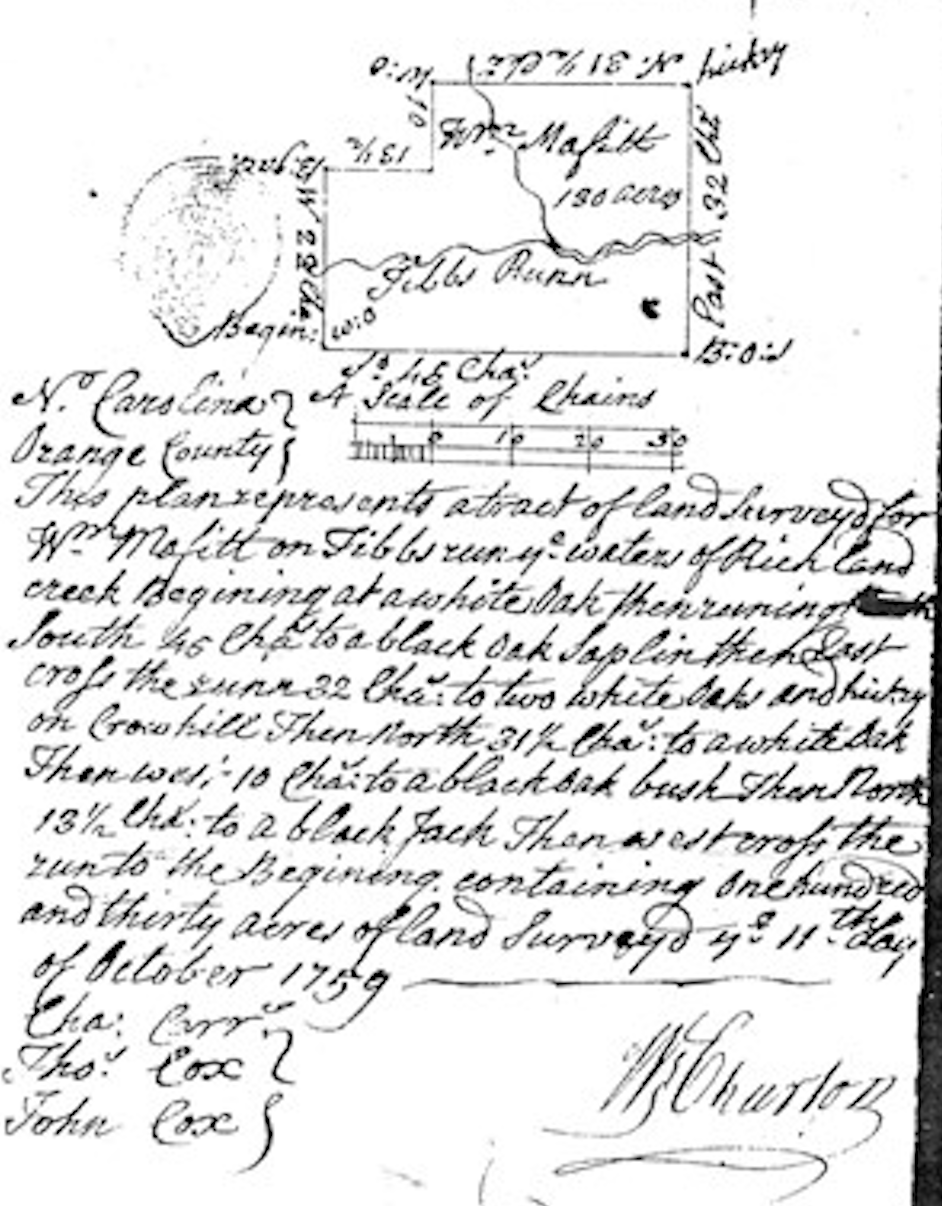
After moving to North Carolina, William obtained two land grants from Earl Granville in Orange County, the first surveyed in 1759 for 130 acres on Richland Creek, then 280 additional acres in 1762 on Brush Creek. His brother, Hugh, also secured a grant for 330 acres near Brush Creek and married Mary’s sister, Hannah Davies. In addition to farming, William and Hugh were said to be skilled millwrights and built “Moffit’s Mill” on the Richland Creek tract.


According to the Cane Creek Meeting records, William and Mary were married on April 2, 1763. Mary was around 23 years of age. She was the daughter of Charles and Hannah (Matson) Davies, early members of the Cane Creek Meeting. (The next generation of the family dropped the “e” to become “Davis.”) The couple’s children were: Naomi (1763), Catherine (1765), Hannah (1771), Mary (1773), Robert (1778), William (1781), and David (1785). I’ve been unable to document a daughter named Margaret (1775) who is occasionally mentioned in Moffitt narratives. The dates also suggest Mary was pregnant before she and William married.
William became involved with backcountry settlers who were dissatisfied with high fees and corrupt colonial officials with heavy-handed tax collection tactics such as confiscation of livestock and property. The group later became known as the North Carolina Regulators. Members of the Regulator movement did not oppose the colonial government and attempted to cooperate with the government to address grievances. In 1766, the colonial court in Hillsborough directed the unhappy settlers to choose representatives, and William was elected to join fellow Quaker William Cox to represent the Deep River area at a meeting to be held at Maddock’s Mill near Hillsborough. Unfortunately, government officials failed to appear at the meeting, and the dissatisfaction would continue to grow with no relief in sight.
The Regulators issued “advertisements”, or public communication, objecting to the practices of local government officials, and William’s signature was regularly found on the documents. He openly (and repeatedly) challenged the local sheriff on the legality of taxes levied on settlers. In April 1768, the sheriff confiscated a local farmer’s horse because he could not pay taxes. An estimated eighty Regulators, including William, went to Hillsborough armed with “clubs, staves, and cloven muskets,” seized the sheriff, and made him sit backward while riding the mare through town. Several bullets were fired into Colonel Edmund Fanning’s Hillsborough home, but he was out of town attending court in Halifax. William’s involvement eventually led to him being excluded from a blanket pardon given later to Regulator members. After 1768, William’s participation with the Regulators is unknown, including whether he was at the Battle of Alamance in 1771.
As Quakers, William and Mary opposed slavery and ran their farm without slave-labor. In addition to operating a mill, the family likely raised hogs, cattle, and horses, and grew crops of corn and grains. Aside from providing supplies to the Continental Army, William appears to have been neutral during the American Revolution, probably as a consequence of the oath (“never to bear arms against the King, but to take up arms for him if called upon”) that he and other Regulators took after the 1771 battle. Most of his children were born after the Regulator period, so perhaps he just wanted to get on with his life. (His Cox in-laws also appear to have been neutral. William’s brother, Charles, married a Cox, and two of his daughters would marry sons of Harmon Cox.)

William died in August 1797 in Randolph County, NC, where his will is recorded in Will Book 2, pages 30-31.

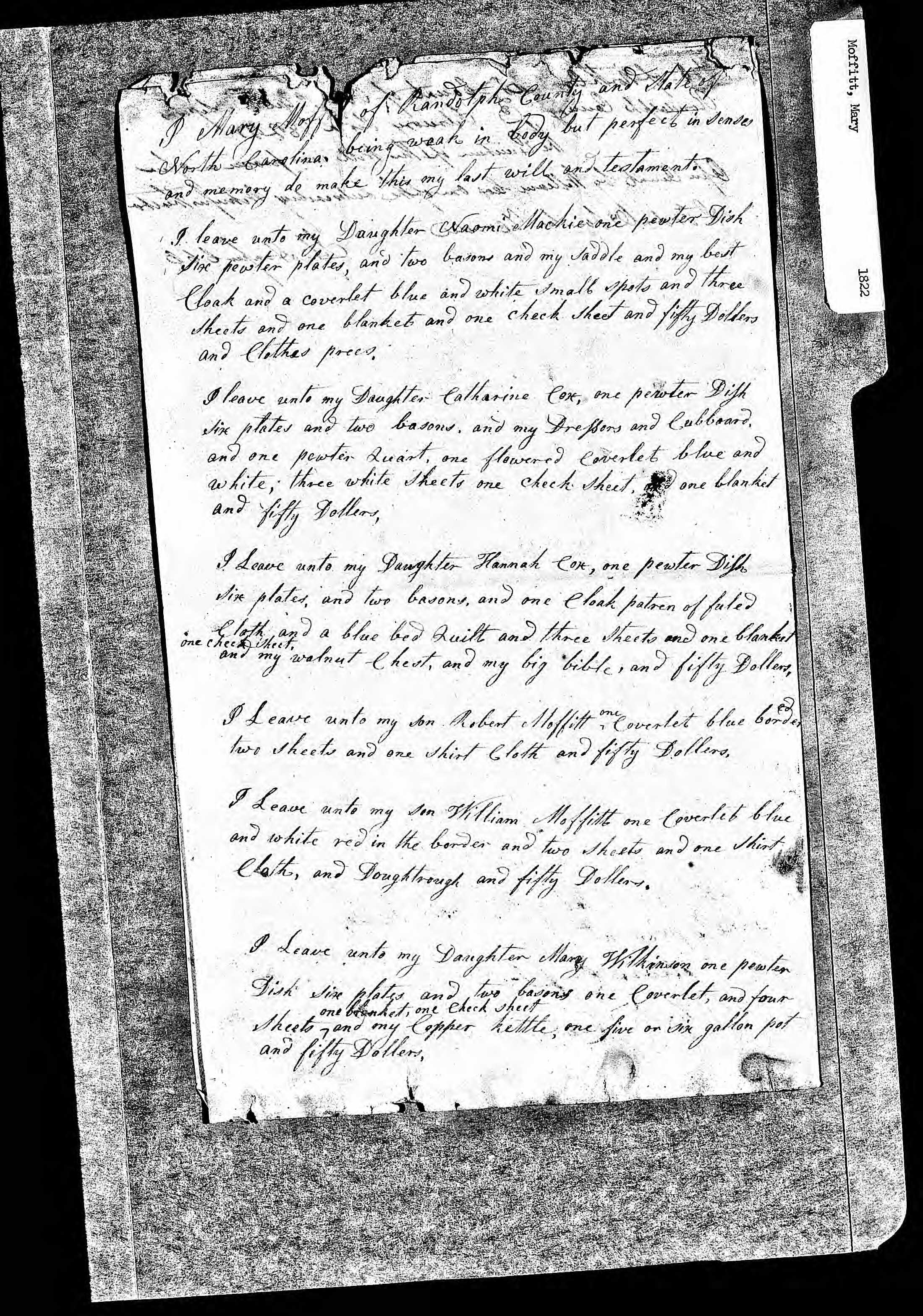
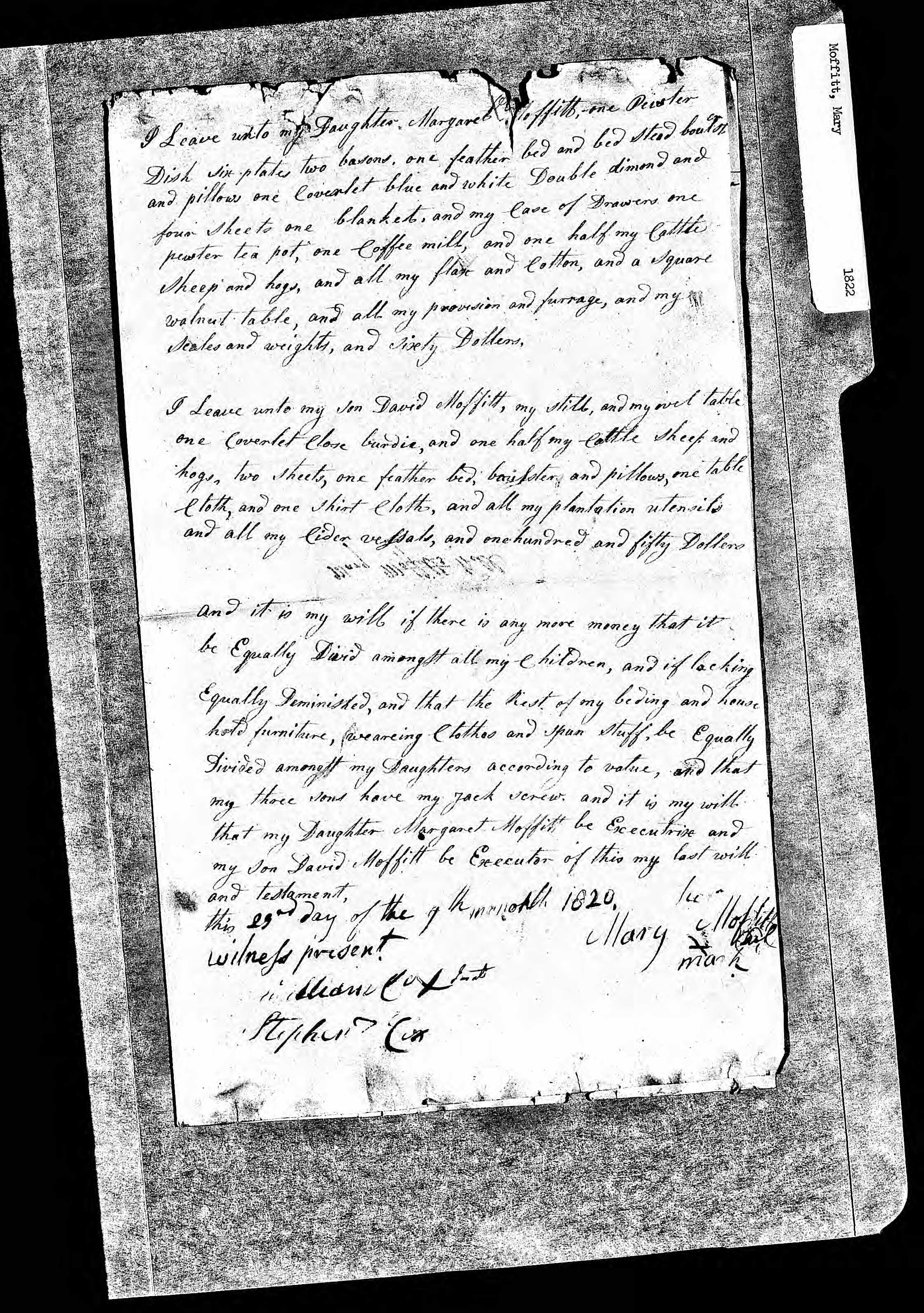
Mary died in 1822, surviving William by almost 23 years. Her will is also in the Randolph County records and shows how intertwined the Moffitt and Cox families were:
Sources of note:
- Moffitt Genealogy: Ancestors and Descendants of Hugh and Hannah (Davis) Moffitt of North Carolina (Family Search account is required)
- Davis : a Quaker family : Charles Davies, the immigrant to Pennsylvania about 1725, from there to North Carolina, his wife, Hannah Matson, and their descendants
- Moffatana Bulletin: An Occasional Publication Vol. 1, No. 1, 1907
- Clan Moffat
- Some Neglected History of North Carolina, Fitch, 1914.
- The Correspondence of William Tryon and other selected papers
 Forebears and Kinfolks
Wonderful history! I am forever indebted to this blog….as it is wonderfully picked up by the internet gods and the issues/chapters prominently listed in Google searches. Wow! THANK YOU❤️
I have a few more notes and a couple of documents about William Moffitt. My notes indicate that he was involved/participated in the Mare incident in 1768 in North Carolina. James Hunter, Ninian Hamilton, Isaac Jackson, John Philip Hartso, William Moffitt, John Pyle, Frances Dorsett, William Butler, Peter Craven, Peter Julian, William Pain, Matthew Hamilton, and Ninian Bell Hamilton were indicted for a rout, and the indictments (except for John Pyle and Peter Julian) were returned a true bill by the grand jury but were squashed. Afraid of keeping these men in prison, the authorities allowed them to escape and sent a pardon after them. According to Tryon, they were released and their fines suspended. Audrey (Cox) Haverkamp