
Thomas Cox, brother of my 5th great grandfather Harmon Cox, is also my 5th great grandfather. Here’s how:
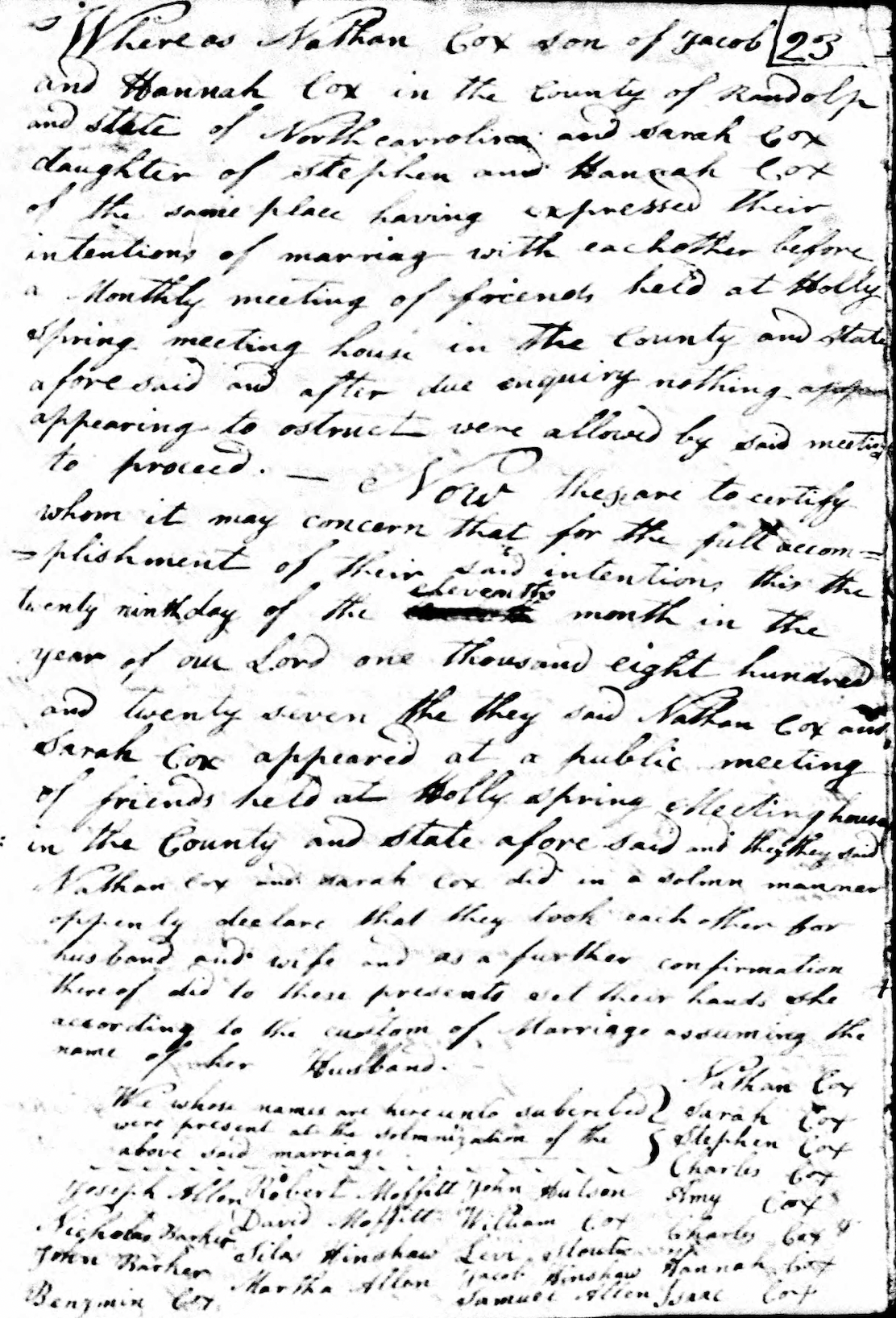
Thomas and Harmon are brothers, sons of William Cox. (William, Jr, John, and Solomon were the other brothers.) The Coxes were Quakers, and discouraged from marrying outside the faith. As one might imagine, this limited the marrying pool considerably. Thomas’s granddaughter Sarah married her cousin Nathan (Harmon’s grandson) producing my 3rd great grandfather Calvin Cox.
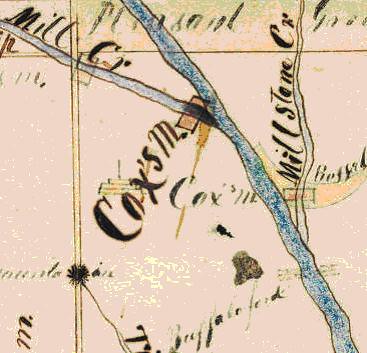
The Cox family moved from Delaware to North Carolina in the early 1750s, secured land grants, and built mills on Deep River in today’s Randolph County.
According to my cousin and family historian Emily Cox Johnson:
“One of the gristmills was located west of Deep River on Mill Creek and run by Thomas Cox. A second was located less than a mile away on the east side of Deep River on Millstone Creek and run by Harmon Cox, a brother of Thomas Cox. The reason two grist mills were being run by a single family so close together was the fact that Deep River is prone to serious flooding any time during the year. These ravaging floods often render Buffalo Ford, which connects the two mills, impassable for several weeks at a time.”
Thomas married Sarah Davis in Cane Creek, NC, on January 24, 1760, when he was 24 years old. They had seven children: Charles (1762) (who married Amy Barker); Thomas Jr. (1763) (wife Sarah Hussey); William (1770) (first wife Lydia Branson and second wife Elizabeth Hinshaw); Mary (1773) (husband Elisha Kenworthy); Sarah (1777) (husband Joshua Hussey); Hannah (1778) (husband Hugh Moffitt); and Stephen (1783) (wife Hannah Cox). The seven year gap between Thomas Jr. and William merits more research to see if a child is missing from the record or perhaps died as an infant.
While there were two Cox mills in the area, the “Harmon Cox Mill” and the “Thomas Cox Mill,” multiple historical accounts cite the Thomas Cox Mill (willed to him by his father William in 1767) as where the Continental army camped in Summer 1780.
Thomas is documented as a patriot in the Daughters of the American Revolution database for his accommodation of the Continental army and militia.
Since all of these Coxes were Quakers, the military leaders knew they could go in and tell the Quakers that they were going to take what they needed.”
Bill Johnson, a local historian who lives near the site of the old mills, and husband of Emily Cox Johnson.
No doubt the Cox mills provided some resources, and the soldiers scouted area farms trying to find whatever they could.
David Fanning, Colonel of the Loyal Militia of Randolph and Chatham Counties, used one of the Cox mills, perhaps even both at times, as his home base in 1781-82. Fanning and his militia conducted raids and tormented supporters of the revolution all over today’s Randolph, Chatham, and Orange Counties.
Records are elusive for Thomas and his family after the Revolutionary War. Presumably he and wife Sarah raised their family in the Quaker faith while he continued to operate the mill. Thomas shows up on the tax rolls. The 1790 census shows Thomas and Sarah living with on their Deep River property with their five youngest children, and with three children ten years later in the 1800 census.
Interestingly, Thomas is one of the few not buried at the old family cemetery. He moved to Ohio in 1808 or 09 to be with his son Thomas Jr, and his family. He died on July 4, 1809. His son Thomas Jr. is why there’s a boatload of Coxes in Ohio today.
Sources of note:
 Forebears and Kinfolks
Thomas was Sarah’s paternal grandfather AND her maternal great-grandfather. Sarah’s father Stephen Cox married his neice Hannah, daughter of his brother Charles Cox and Amy Barker. A little bit of an ick factor in the Quaker Cox family tree.
As my dad used to say, the marrying pool wasn’t very big back then!