
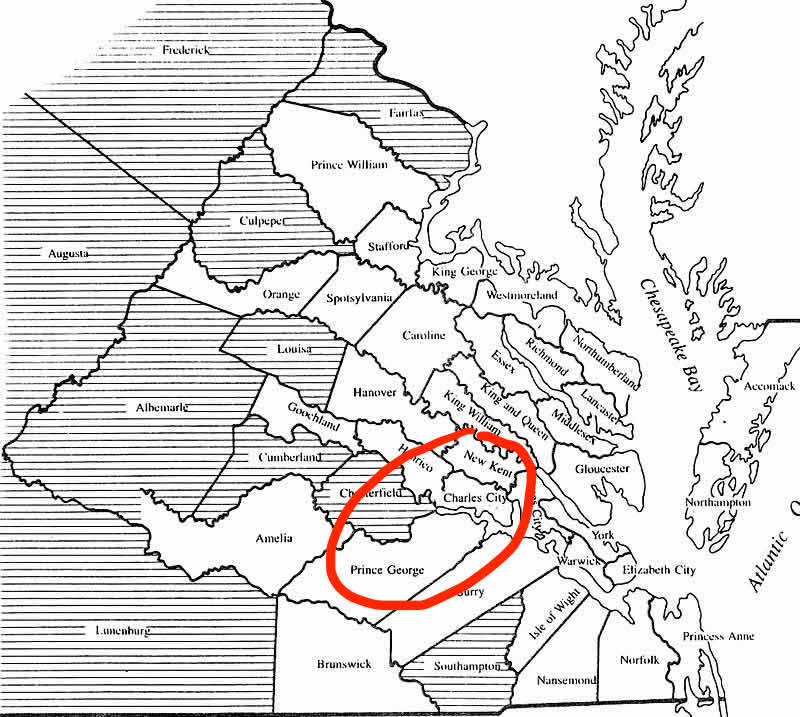
William Moody Sr. is my fifth great-grandfather. A comparison of genealogies and available records leads me to believe he was born sometime between 1740 and 1743 in what is today’s Charles City County and Prince George County area of Virginia. Several men named “William Moody” lived in the region. Another William Moody from York (Charles River) is sometimes interchanged in genealogies, but the timelines and relationships don’t hold up.
Most of the Moodys in Chatham and Randolph County can trace their lineage back to “our” William who migrated to North Carolina by 1764. That’s the year “William Moode” purchased 560 acres of land from Joseph Trotter in Orange County. Trotter acquired land in 1763 from the heirs of Henry McCulloh, who had in 1737 obtained from the King of England the right to grant 1.2 Million acres of land in the North Carolina Piedmont. These tracts were twelve squares of 100,000 acres each, subdivided into smaller tracts as proportionate shares for smaller investors. The 1764 purchase record provides reason to believe William would likely have been in his early twenties and born earlier than 1744, which helps separate him from the “other” Virginia-born William Moody.
(Ultimately conflicts emerged between the McCulloh grants and the Lord Granville grants resulting in a lot of deed gyrations in the 1760s. Trotter most likely had the land before 1763 (he is on the 1755 Orange County tax rolls) with the transaction date being part of the truing up process.)
William frequently appears in Orange and Chatham County court records over the next few decades. Since Orange County was formed 1752 from Granville County, and Chatham County was formed from a part of Orange County in 1771, the records are consistent enough to conclude our William was purchasing and living on “Chatham” land and not relocating.
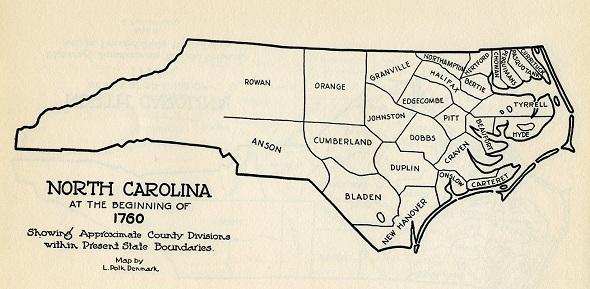

The birth of his second son Thomas was recorded in Granville County in 1765, followed by the birth of his third son Benjamin (my 4th great grandfather) recorded in Orange County in 1767. This suggests William had not yet moved to the land he purchased from Trotter in 1764. On July 3, 1770, Robert Cate(s) of Orange County sold 225 acres to “William Moody of the same place” on the south side of the Haw River, which is today’s Chatham County. He was a chain carrier in 1779 for a land grant survey for William Goldston and bought 640 acres of land on the south side of Lick Creek from William Goldston in 1785. In 1787 William sold 225 acres of land to William Douglas on the south side of the Haw River at Crow’s Ford. Witness was his son, Benjamin Moody.
William was appointed “overseer of road from Widow Headen’s to Thomas Beal’s” by Chatham County in 1785. County courts appointed road overseers to keep roads clear of obstacles and marked. Overseers were empowered to summon freemen or their servants to perform work deemed necessary. This suggests William Sr. (son William Jr. was born in 1775) had become a person of status in the area. (From this point a distinction between William Sr. and William Jr. will be made.)
William Sr. was married twice and had eleven children. Because of the aforementioned confusion with other William Moodys in genealogical narratives, there is uncertainty as to the name of each wife. His children, however, are specifically named in the court records dividing his estate among heirs. The order as named in 1831 (but not in order of birth): (1) Thomas, (2) Benjamin, (3) William Jr., (4) Joel, (5) Riley, (6) John, (7) Betsy, (8) Gilley (sic), (9) Patsy, (10) Frances (Franky), and (11) Ezekiel.
Each of the daughters married: Betsy (Elizabeth) to Jonathan Miles, Gilley to John Willett (second marriage for both), Patsy, (also referred to as Martha) to Henry Bray, and Frances to Thomas Elliott.
Some genealogical references cite a woman named Jackson as William Sr.’s first wife, but more confirmation is needed. The children from this marriage are: John (1762–1829), Thomas (1765–1851), Benjamin (1767–1854), Frances “Franky” (1769–1860), and Joel (1771–1852).
William Sr. remarried in 1772 (perhaps to a “Barbara,” “Barbery,” or “Barbary”). A person by that name is shown as owning land in the 1815 Chatham tax records.

The children from his second marriage are: Ezekiel (1772–1810), William, Jr. (1775-1832), Riley (1777-1857), Elizabeth “Betsy” (1783-?), Gazzelle “Gilley” (sic) (1786-1830), and Martha “Patsy” (1788-1860).
Records show William Sr. also owned 272 acres in Randolph County:
“on the waters of Polecat (Creek) adjoining the lands of Vestal Burson, William Burson & others, one other tract of land lying and being in the County last aforesaid on the waters of Polecat adjoining the lands of William Burson and others containing seventy acres, one other tract of land lying and being in the County last aforesaid on the waters of Sandy Creek and adjoining Col. Isaac lane, Jonathan Burns and others containing one hundred and twenty acres.”
(Estate Records of Randolph County, North Carolina, 1781-1921, Moody.)
Also per court records, William Sr.
“held and possessed of several tracts of land lying and being in the County of Chatham…one tract of land lying and being on the waters of Tick Creek adjoining the lands of Thomas Ragland and Terrell Brooks and others containing six hundred and forty acres. Another tract adjoining the lands of Nathan Bray, Thomas Craven and others & lying and being on the waters of Flat Creek containing six hundred acres. Another tract lying and being on the waters of Bear Creek adjoining the lands of James Carter and William Glass and containing forty acres.”
(Estate Records of Randolph County, North Carolina, 1781-1921, Moody.)
That’s over 1500 acres in Chatham and Randolph County at the time of William Sr.’s death in 1818. Unfortunately, he died without a will, and a twenty-year battle to settle his estate ensued. Benjamin and Patsy’s husband, Henry Bray, served as executors of the estate.
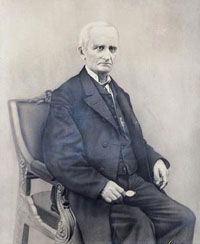
In the early 1800s, probate matters were referred to the County Court of Equity. (Criminal and complex civil cases were handled by the Court of Pleas and Quarter). Records regarding the William Cox Sr. estate appear in Randolph County court files by December 1818. Future Governor Jonathan Worth, shown on the right, is among the attorneys and court officials dealing with estate claims over the next two decades.
Disputes among the children were generally aligned in two groups: Benjamin, Riley, John, Patsy (Bray), Gilly (Willett), Betsy (Miles, widowed), and the heirs of Ezekiel (died 1810) on one side, and William Jr., Thomas, Joel, and Frances (Elliott) on the other. Thomas and Joel were living in Georgia by 1820, and Frances’ husband Thomas died in 1824. (There’s also inference in documents that Thomas Elliott and Frances may have separated before his death.)
In December, 1818, administrators of the estate filed with the Randolph Court of Equity an initial inventory of property and papers belonging William Sr.:
“seven head of cattle, five head of sheep, one large stock of hogs, three beds and sides, one wagon and cover, five head of horses, two bar ploughs, two mattock and four hoes, two pare plough geers (sic), one still and tubs, one crosscut saw, one chest and cupboard, one chest and table, trunk, four jugs, four chairs, one half dozen pewter plates, one dozen Delph (sic) plates, one pewter dish and three basons (sic), one set cups and saucers, one large tumbler, two black bottles, one barrel brandy, two raw hides, one loom, four wheels – two cotton two flax (sic), one churn two washings tubs, two pots two ovens one skilet (sic), one frien (sic) pan and tea kettle, one coffee mill, one rifle gun, several balls, some carpenter tools, one hachet (sic) and four sides of leather.”
(Estate Records of Randolph County, North Carolina, 1781-1921, Moody.)

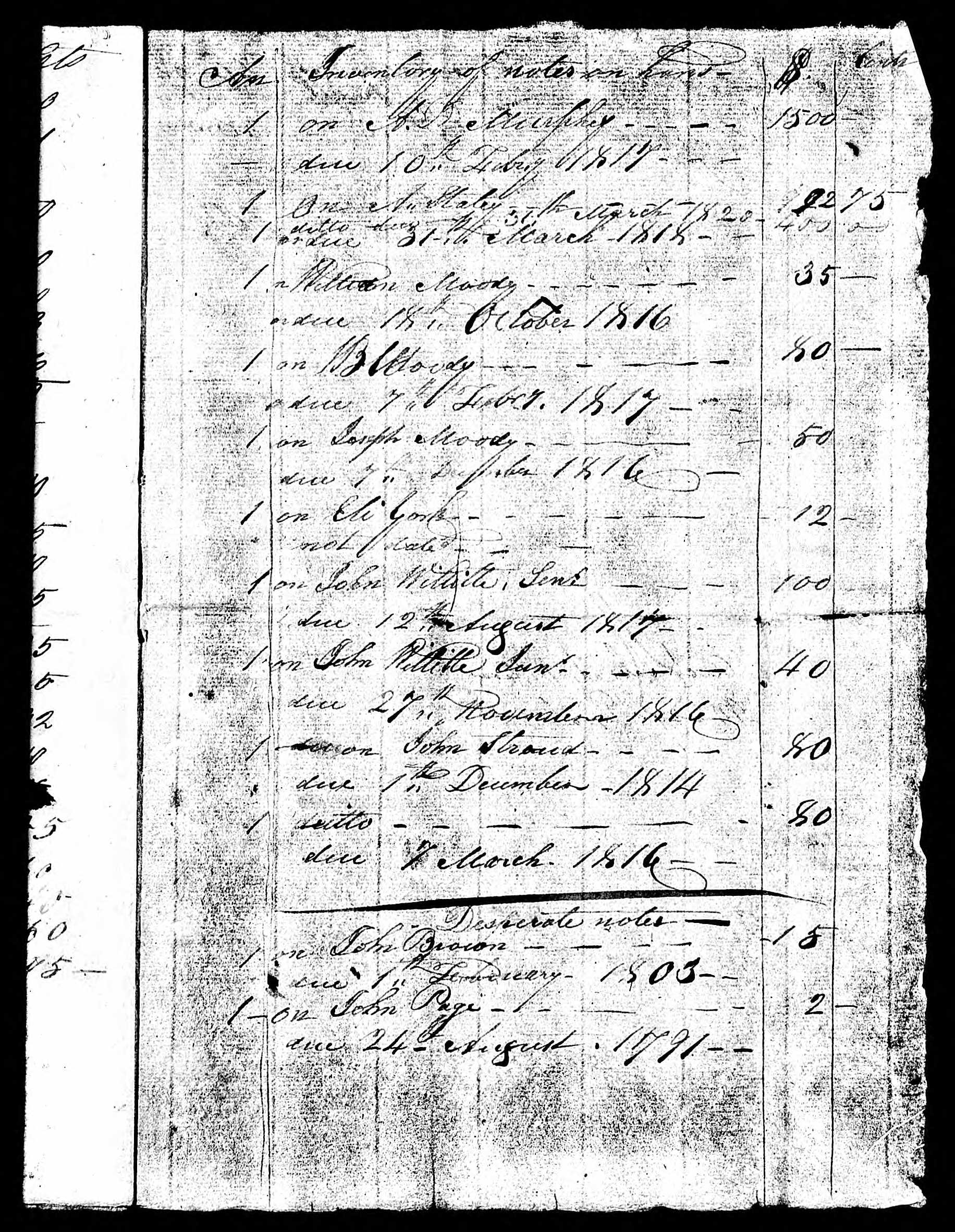
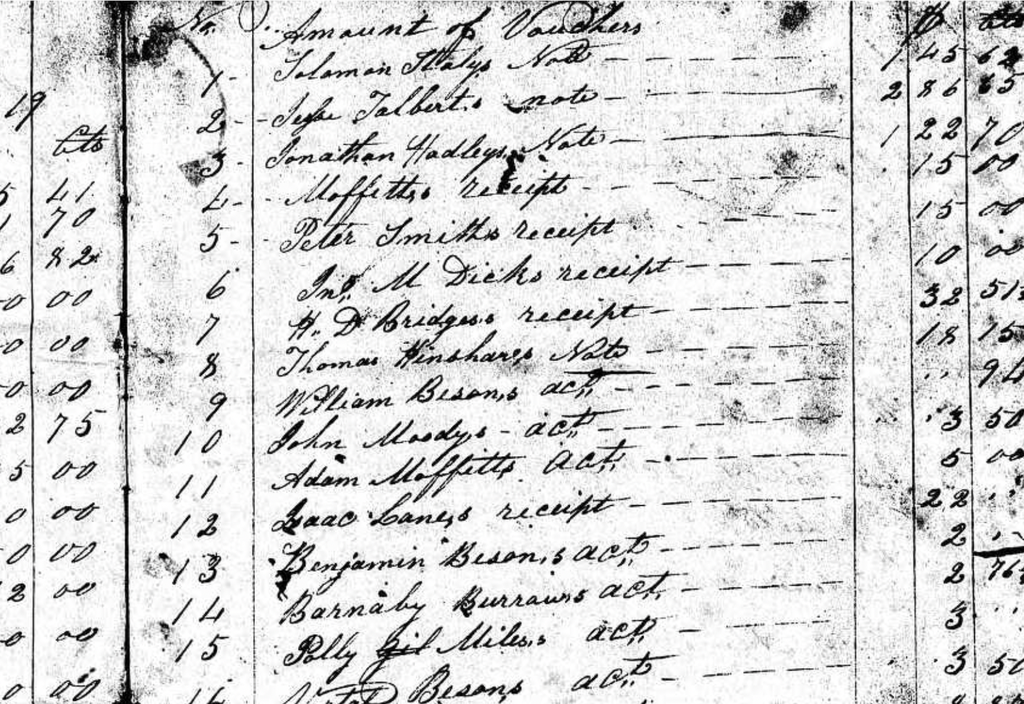
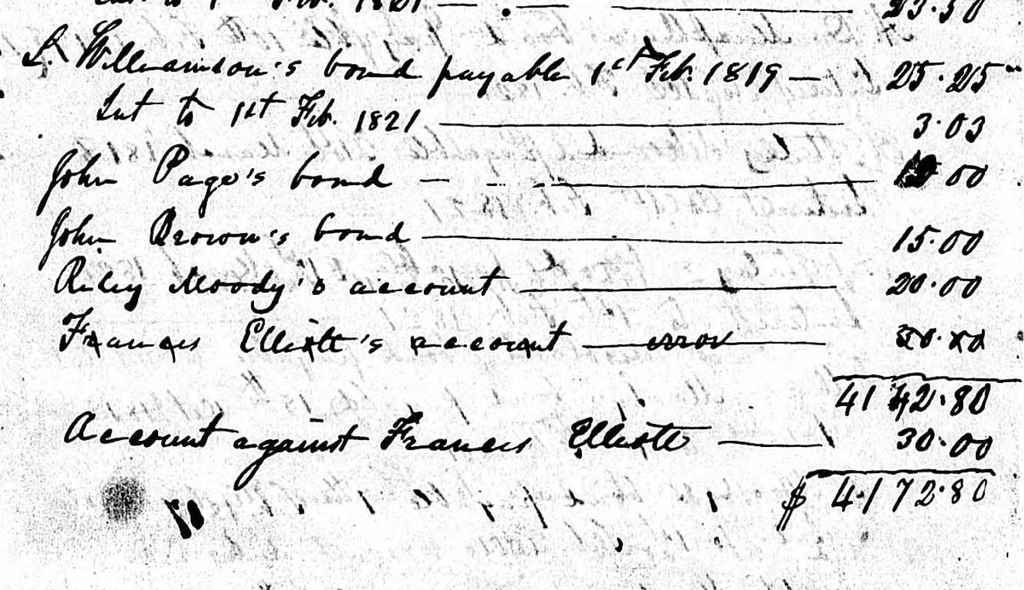
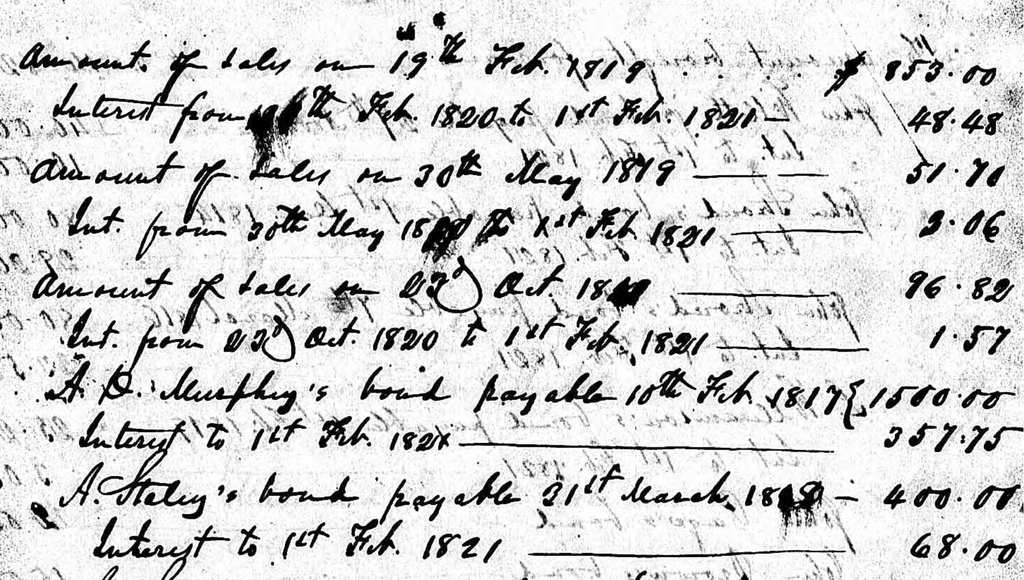
An additional inventory was submitted in February 1819 following a public auction of the estate. Of particular interest is a series of “notes on hand owed to the estate.” Some were with his children, and others to people in the community. From Randolph County 1779-1979, Randolph County Historical Society (N.C.), Randolph Arts Guild:

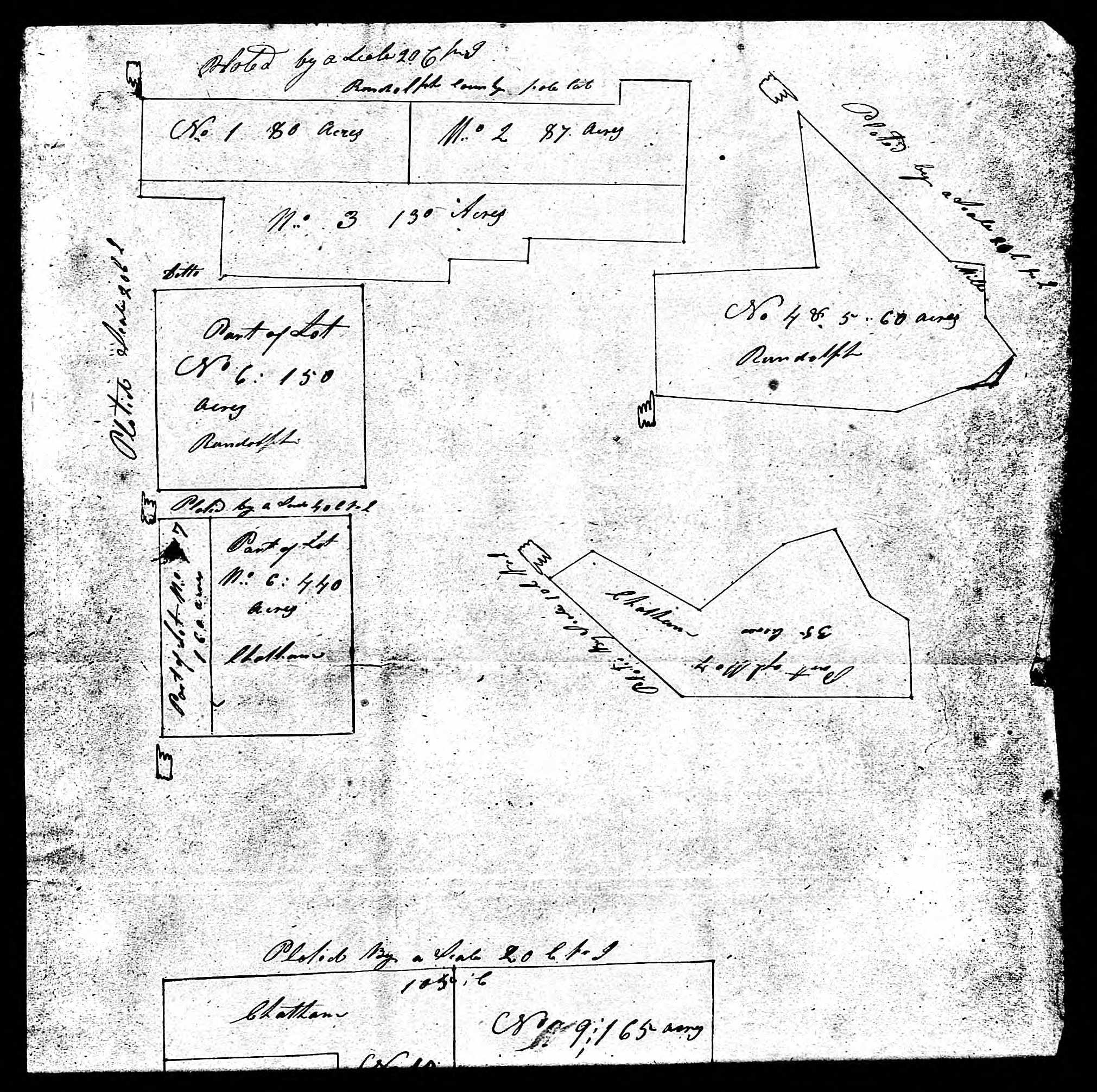
An division of land was recorded on April 22, 1820:
| Recipient | Tract # | County/Waters | Acreage |
|---|---|---|---|
| Betsy | 1 | Randolph Polecat Creek | 80 |
| John | 2 | Randolph Polecat Creek | 87 |
| Heirs of Ezekiel | 3 | Randolph Polecat Creek | 130 |
| William/Frances | 4/5 | Randolph Polecat Creek | 60 incl the mill |
| Thomas | 6 | Randolph Sandy Creek | 150 |
| Joel | 7 | Chatham Bear Creek | 160 |
| Patsy | 8 | Chatham Tick Creek | 124 |
| Riley | 9 | Chatham Tick Creek | 145 |
| Benjamin | 10 | Chatham Tick Creek | 440 |
| Gilly | 11 | Chatham Tick Creek | 150 |
William Jr. and his sister Franky (Frances) received a joint distribution of land that included a mill.
William Jr., Riley, and Benjamin were already landowners before the estate settlement. Chatham County tax records for 1815 show William Jr. with 220 acres, and Benjamin with 70 acres, on Tick Creek. Riley owned with 210 acres on Bear Creek, and Joel and Thomas owned property in Georgia.
There are 472 pages of estate settlement documents spanning 20 years, and those most frequently in conflict are Patsy’s husband Henry Bray, and Frances. In 1830, Henry Bray and Patsy sold their land in Chatham and Randolph Counties and moved to Greene County, Alabama. This no doubt further complicated estate settlement claims between Frances and Henry as stated in a July 7, 1832 deposition.
After leaving NC, Henry is deposed out of state, summoned on occasion to return to Randolph Court with the Sheriff ordered to “bring the body of said Henry Bray before the court,” and even prohibited him leaving the County after he was here.
A deposition of Benjamin Moody less than two months later suggests Frances’ residency on the land where William Sr. lived at the time of his death was also a factor in the overall dispute. The September 1, 1832 transcript:
“Benjamin Moody…duly sworn desposeth (sic) and sayeth (sic) as follows to wit,
Question: Did you and the defendant H. Bray rent the plantation on which William Moody decd. resided at the time of his death to Frances Elliott?
Answer: I had no hand in renting it to her nor do I know that he rented it to her. We talked of renting out the lands of the deceased but concluded, as several of the children lived on the lands of the intestate, that we would not rent any of it out, except the mill tract.
Question: What would have been a fair price for rent of the plantation on which your father died for one year?
Answer: The plantation was out of repair…Perhaps it would have rented for $10 a year.
The notes held by the estate also added to the disputes. For example, a claim of “$50 which is due to Joel Moody in the division of the lands of his father William Moody dec. which money is due from the lots number four, five, and eight on judgment against Riley Moody for seventy six dollars, fifty eight, and a half cents and interest. Randolph Supperior (sic) Court September term 1832.” There are numerous pages in the file attempting to reconcile claims. ($50 at this time would be equivalent to around $1100 today.)
A definitive final settlement summary of all claims may exist in the files, but the documents are not in chronological order and some images are poor quality. Sons John and William Jr. died in 1829 and 1832 respectively. Daughter Gilly died in 1830. With Thomas and Joel already in Georgia, and Henry Bray and Patsy in Alabama, the last few years of claims appear to boil down to a Frances grudge match against Henry Bray. By 1838 the files end. Maybe she just gave up.
An Elliott family genealogist provided some insight on the Frances Moody Elliott and Son-in-Law Henry Bray) dispute:
“Frances R Moody, daughter of William Moody of Chatham and later Randolph Co., NC, married Thomas Elliott, 20 Nov 1813 in Asheboro, NC. She was the mother of Jesse Torrence Elliott who died fighting in the Civil War in VA, and Emiline M Elliott who is buried in SC near the children of Jesse and Jane M Allred Elliott. There are dozens of documents naming her, in her father’s estate file (NC Archives, Raleigh,) and she filed a plea to the General Assembly to own her inherited property outright, in her own name(General Assembly Papers,NC Archives, filed with divorce petitions-even though no divorce was asked for or granted.) These documents tell the tale of a strong, feisty, independent woman who raised her children alone without support from a wandering, black-sheep husband. Thomas Elliott, despite hailing from an esteemed Randolph family, was sentenced to Federal Prison for stealing a Silver Certificate from the mail during his term as Postmaster in Asheboro, NC. Franky sold everything they owned to pay for his defense, and she and her children would have been destitute if the Elliott family had not helped them. When Thomas was released from jail, he ran off out of state with a “lady of the evening” he had met in Raleigh during his prison term. The Elliott family rallied many prominent Asheboro families to sign a petition pleading for a Presidential pardon for Thomas. The original petition and the draft copy of his granted Presidential pardon are housed at NARA (College Park, MD-James Monroe Papers.) Thomas Elliott died with 50 cents to his name (Probate NC Archives, 1823) but Frances and her children lived comfortably due to the property she inherited from her father, and kindness of Thomas’ brothers. (Land records, NC Archives)”
In an email, the genealogist adds:
Henry Bray leaving the state before closing out the settlements was a major part of the dissatisfaction re the distribution of William’s goods. They thought he took more then his share and had him brought back to NC, arrested and put in jail. Frances was in court contesting the valuation of a horse she received-she thought it was worth $15 and her siblings thought it was worth at least $40 or so. She also evidently got $30 from her father to rent a fancy horse and buggy to parade around Asheboro on her wedding day. She insisted it was a gift. Her siblings wanted the $30 charged against her part of the estate because they said it was a loan. They went to court 6 different times over just this part of the dispute.
It’s unclear where William Sr. is buried. The exact date of death is also uncertain as the date generally cited is when estate filings appear in court records. His second wife isn’t mentioned in the estate settlement, so clearly she was deceased at the time of his death. The lack of marriage records probably means William Sr. wasn’t a member of an established church.
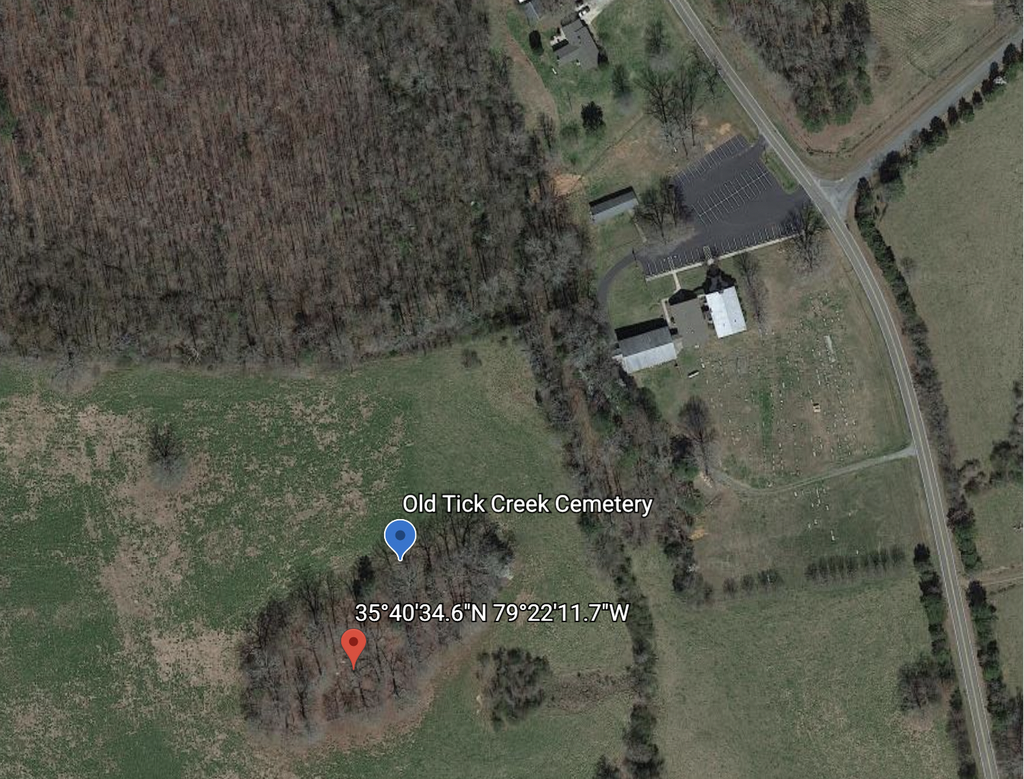
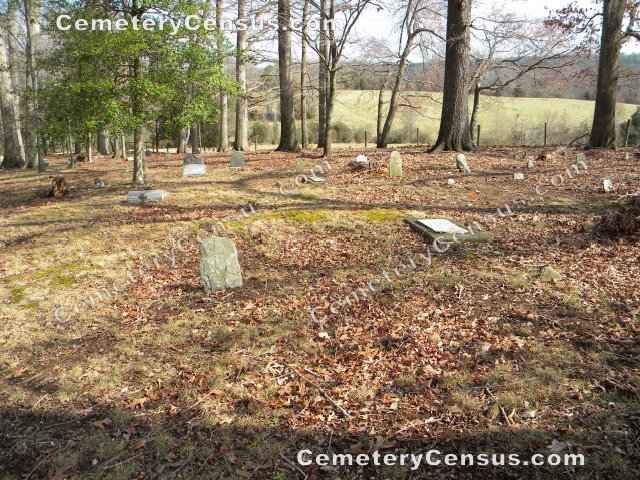
One burial possibility is the Old Tick Creek Cemetery near Rives Baptist Church in Chatham County. Some of William Sr.’s contemporary Chatham landowners are buried there, and the plot inventory shows a number of unidentified graves. Since he was residing in Randolph County at the time of his death, more research is needed.
It also appears William Sr. may have owned slaves. The first thorough slave census was conducted in 1850. Census records confirm sons Joel and Thomas owned slaves in Georgia, as did several nearby Chatham County contemporaries and land owners. Earlier censuses had a column for the number of slaves, and the 1810 Randolph County census can be interpreted as showing William Sr. with six slaves. The online copy (handwritten with unruled columns) isn’t the best, but there is at least one mention of a slave in 472 pages of estate details, so I have to assume this is an unfortunate fact.

One last thing: there is an entry of whiskey expensed to the estate for conducting the sale of assets. One can assume Grandpa William didn’t object to strong drink.

Sources of note:
- Chatham County Historical Society
- Mark Chilton’s Blogs
- NC Dept of Cultural & Natural Resources
- Descendants of William Moody of Chatham County, North Carolina: a family history including private and public records and letters, written recollections and oral traditions, Deason Hunt
 Forebears and Kinfolks